Written for owners of Singapore businesses who keep hearing that they need to “optimise for AI Overviews”, and want to know what actually gets a business named.
The short answer
Getting into Google’s AI Overview in Singapore starts with the question you choose, not with how you format the page. Pick specific questions that buyers ask right before they choose, where nobody gives a good answer yet. Then answer each one better than anyone else, with every fact sourced.
The usual tips (question headings, short answers, FAQ markup) are fine housekeeping. They won’t get a small website picked for a question hospitals and big brands already own.
Read this first: we sell this kind of work. The clinic in our examples is one we publish for, and its results are shown with its permission.
Key takeaways
- The AI Overview works like a shortlist. In a 2026 research study of 55,393 searches, nearly 30% of the websites it cited weren’t on page one at all.
- It mostly appears for questions. The same study saw it on 13.7% of all searches, and on 64.7% of searches phrased as a question.
- A small website can get in on the specific questions nobody has answered well. The big, crowded searches come later.
- We watched it happen. A Singapore chiropractic clinic with a low authority score had guides cited in Google’s AI Overview within hours of going live.
- Formatting tips and markup are the small lever. Google says no special markup or files are needed.
What Google’s AI Overview in Singapore actually is
Google’s AI Overview in Singapore is the AI-written answer that now sits above the normal results for many searches. It answers the question in a few lines, and it shows a small set of sources beside it. When someone asks for a provider, it often names two or three businesses.
That makes it a shortlist. The person searching reads the answer, sees the names, and often stops there. A research paper published on arXiv in August 2026 tracked the browsing of 900 US adults. It found that people clicked on a source cited in the AI Overview on only about 1% of visits. So the prize is being named in the answer.
It also doesn’t appear for every search. A research paper on arXiv that ran 55,393 trending searches between 13 March and 21 April 2026 found an AI Overview on 13.7% of them overall, but on 64.7% of searches typed as a full question. When we searched the title of this post on 25 September 2026, Google showed no AI Overview at all, only a page of agencies offering to optimise for one.
Said plainly
The AI Overview shows up when someone asks a real question. So the questions your buyers ask are where you can be named.
What the usual advice gets wrong
Search for how to get into the AI Overview in Singapore and you’ll find the same list on nearly every page. Here’s how it compares with what moved the results for a clinic we work with.
The usual checklist
- Question-style headings
- A 40 to 80 word answer under each one
- FAQ sections with FAQ markup
- Author bios and “last updated” dates
- Schema for your business and articles
- Singapore words sprinkled through the page
What moved it for the clinic
- Choosing specific questions buyers ask right before they book
- Skipping the searches hospitals and big brands already own
- Answering each one better than any other page, from real experience
- Linking every fact to its source
- Publishing steadily, then carrying the answers onto other sites
Nothing on the left is harmful. Clear headings help readers, and a direct first answer is good writing. But it’s the tidy-up, not the reason a business gets picked. Google’s own guidance says you don’t need new machine-readable files, AI text files or special markup to appear in its AI features. We went through every markup claim in what schema can and can’t do for AI search.
If every page on a search follows the same checklist, the checklist can’t be what sets one of them apart.
Why ranking tricks don’t decide it
Most AI Overview advice assumes it simply repeats page one. The research says otherwise.
- It cites pages that don’t rank.In that same 55,393-search study, nearly 30% of the websites cited in AI Overviews weren’t on the first page of results for that search.
- It draws on a different set of sources.A separate arXiv paper, 11,500 searches tested in Google Search, Gemini, and AI Overviews, found the sources in normal Google results and in AI Overviews barely overlapped.
- It changes from run to run.The same study found AI Overviews were less consistent. Run the same search twice, or change one small word, and the sources can change.
So you’re not being ranked into the AI Overview. You’re being chosen as the answer. That’s good news for a small business, because page one on a crowded search is out of reach, and being the best answer to a narrow question is not.
Start with the question, not the page
This is where our experience goes against most of the advice. The first decision is which question to answer. Formatting comes later.
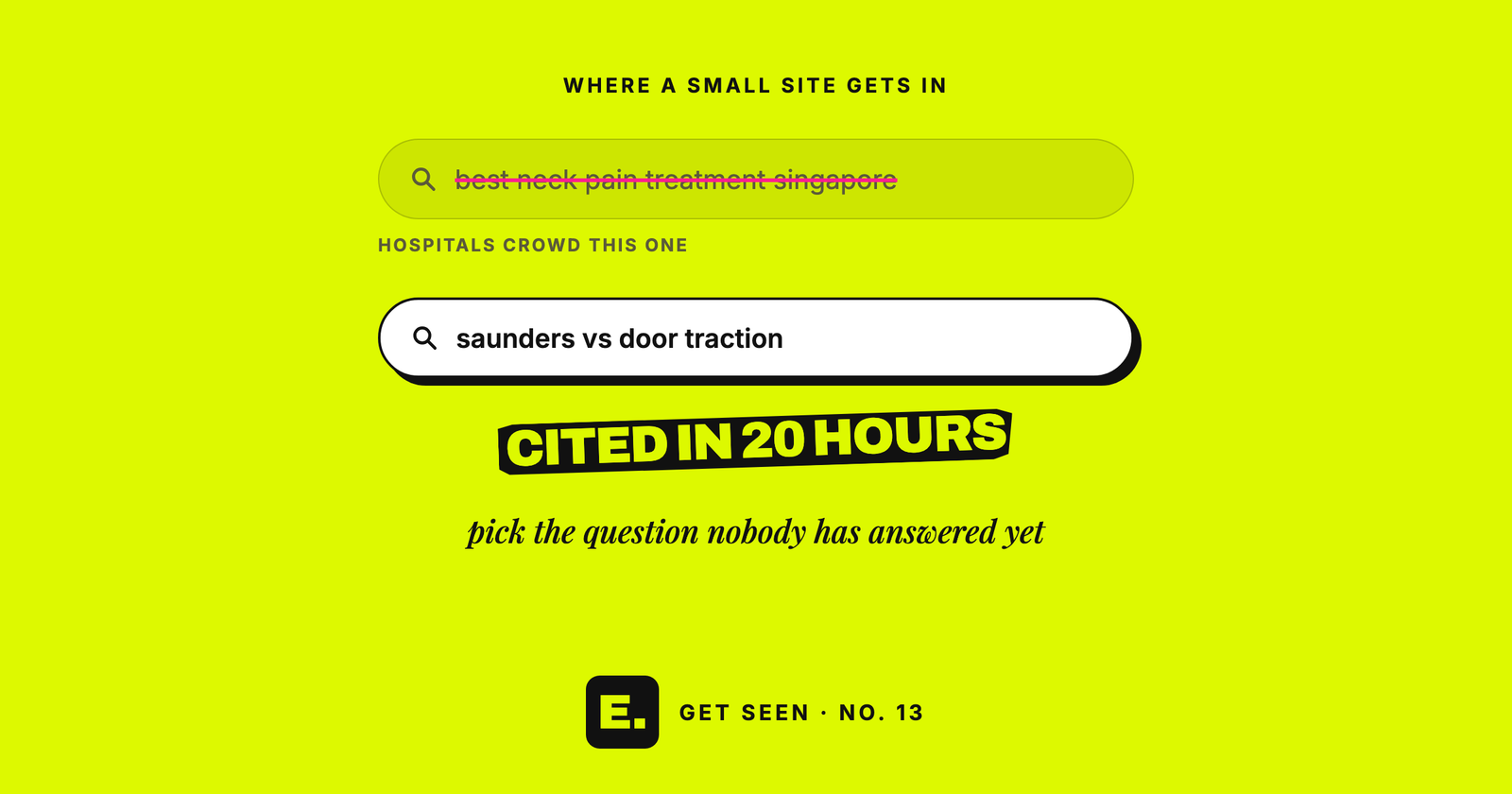
A small website without much reputation won’t be cited for the big, crowded searches. Google doesn’t trust it yet, and it shouldn’t pick a newcomer over a hospital for “neck pain specialist”. But a site’s authority score isn’t the gate either. Dr Neck Pain, a chiropractic clinic in Singapore we publish for, started with a low one.
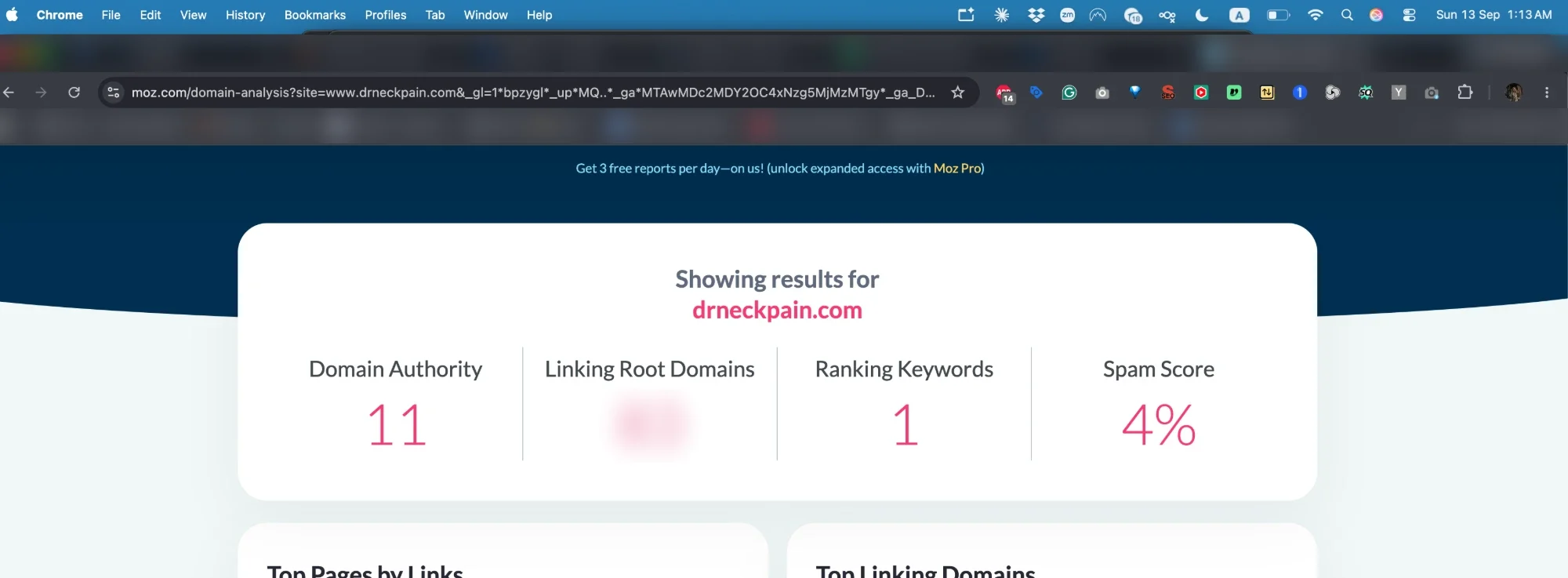
With a score like that, going after “best neck pain treatment Singapore” on day one would have meant fighting hospitals and specialist groups for the same few spots. We did the opposite.
We answered very specific questions from people who were about to choose, where nobody gave a good answer.
Fewer people search them. The ones who do are close to booking, and Google has little else worth quoting.
These are the kinds of guides the clinic published. Each one answers a question someone asks while comparing their options:
- Dry needling vs acupuncture for neck pain. Ranked third on Google the day it went live and was cited in the AI Overview.
- Physio vs massage therapy for neck pain. Ranked first for its search and was cited by name.
- Balance ball vs ergonomic chair. Became the first source in the AI Overview one hour after going live.
- Saunders vs over-the-door traction for neck dizziness. Became the first source in the AI Overview within about 20 hours.
None of these is a big search. Every one is a question from a person who already knows they have a problem and is deciding what to do about it. The AI Overview shows up for exactly that kind of question, and few pages answered it properly.
How each guide is built
Picking the question is half of it. The other half is being the best answer on the internet to that question. Each guide follows the same basic shape.
The shape of each guide
One question, answered better than anyone else.
- The answer comes firstThe first two sentences answer the question directly, so a reader or an AI can lift them as they are.
- A side-by-side comparisonA table puts the two options next to each other on the things a patient actually weighs.
- Who each option suitsEach guide says when one option makes more sense and when to see someone in person.
- Every fact linked to its sourceWe check each medical point against published research and link it, so nothing rests on opinion.
- The follow-up questionsThe questions people ask next are answered at the end, each in a few lines.
- Plain wordsIt’s written so a patient understands it on the first read, not the way a textbook would put it.
The part we keep to ourselves: how we find the questions, and the order we publish them in.
Health topics are held to Google’s strictest standards, and Singapore limits what clinics may say in advertising. The guides stay educational and factual, and the clinic approves every topic.
The shape isn’t the secret. Plenty of pages have tables and FAQs. What made the difference was pointing that shape at a question nobody else had answered well, and making the answer good enough to quote.
How we know it works
These are dated captures from Google in a private window, taken as the guides went live.
How we know
A guide cited first within about 20 hours. The clinic published its guide comparing Saunders and over-the-door neck traction on 22 September. By 1:43pm the next day, Google’s AI Overview opened with a sentence taken from it, and the clinic was the first source, above two physiotherapy YouTube channels.
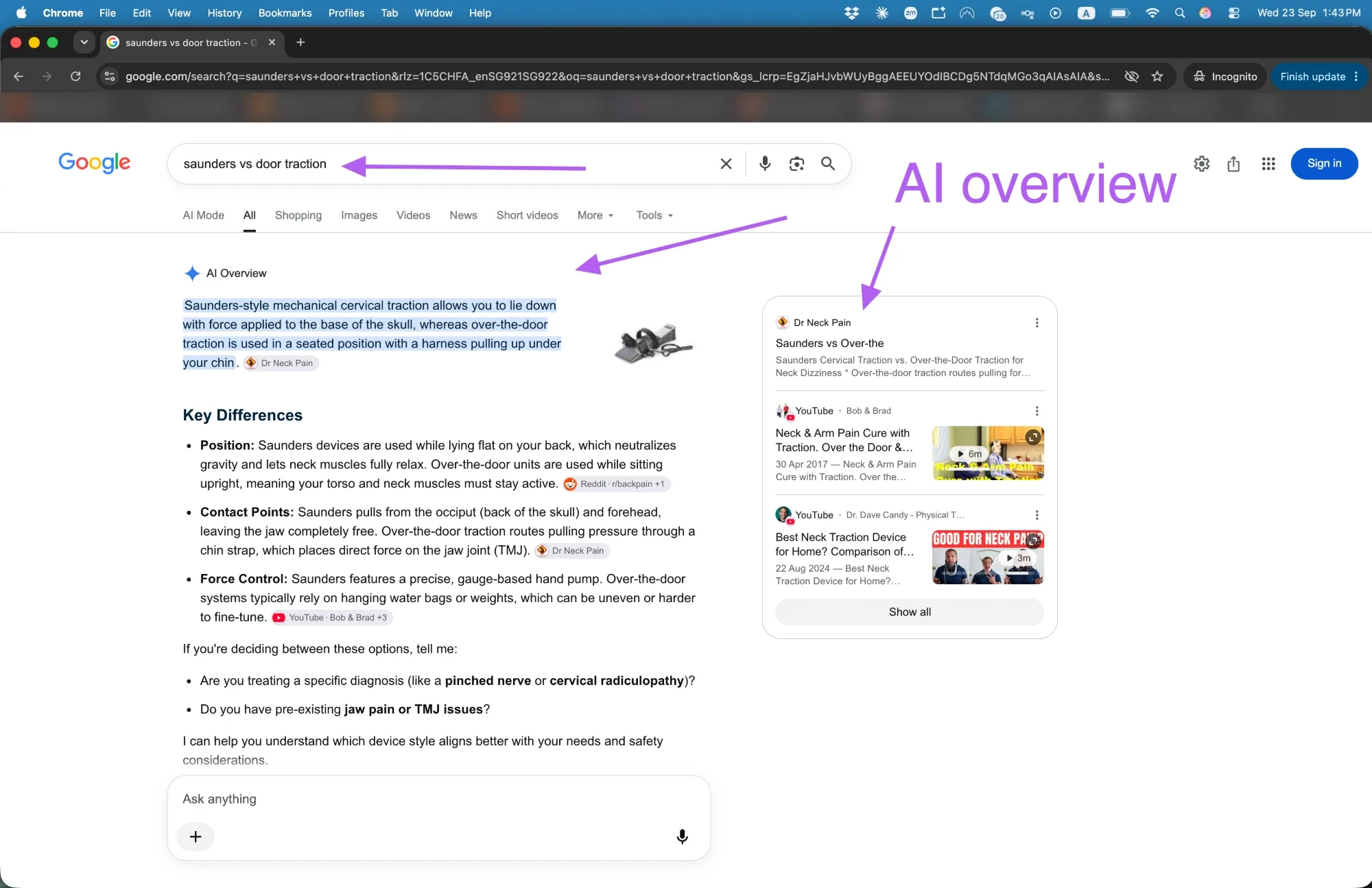
Google, private window, 23 September 2026, 1:43pm. Purple arrows mark the answer sentence and the clinic as first source. The same page was also first in the normal results.
It wasn’t a one-off. Other guides were cited in the AI Overview within one or two hours of going live. For some, the AI Overview’s headline answer was credited to the clinic alone.
The narrow wins led to the hard one. On 17 September, Google’s AI Overview listed the clinic second for “the best neck pain specialist” in Singapore, above a medical pain clinic and a private hospital group. That search took weeks, not hours.
The guides pull more than their weight in AI answers. In the clinic’s Google Search Console, the new guides earned about 31% of the site’s appearances in Google’s AI answers, against about 16% of its appearances in normal search.
Why the clinic moved this fast, and why that matters for you
A low authority score didn’t mean the clinic started from nothing. It had been open for years, and it had real patient reviews on Google. So when its guides answered a question well, Google had other reasons to trust the name behind them. The topics were also very narrow, which left little competition.
Our own website is the other end of the scale. We opened our offer to the public in September 2026 with no traffic, no reviews, and a name Google’s AI didn’t know yet. So we choose our topics differently, and we expect it to take more time and steady work. We’re doing it in the open, so the proof will be ours too.
Said plainly
Great answers get you in faster when people already vouch for you. If your business has good reviews, you’re closer than you think. If it doesn’t, that’s the first thing to build, and it’s what Ranked., our Google Maps and reviews service, is for.
Specific questions moved first, and the competitive search followed. That’s the order we plan for with every business: the narrow wins come quickly, and they build the trust that the bigger searches need. If you want to see how this looks for your own business, here’s what our audit report shows, page by page.
Then take the answer off your own site
Great answers on your own website are one of two things that get a business named. The other is other people talking about you: news pieces, videos, podcasts, lists and forum threads that mention your name. Together they compound.
For the clinic, we did both. After two weeks of guides, the first MultiCasting campaign, our publishing service, went live on 14 September. It turned the same answers into articles, videos, podcasts and news pieces across hundreds of sites. The clinic’s appearances in Google’s AI answers stepped up again around the day it launched.
The honest limit
The guides were already lifting the numbers before the campaign started, and both were running together. The data can’t split the credit between them, so we don’t. What we can say is that the guides plus the first campaign did this together.
We explain the second half in more detail in how to get your business mentioned in ChatGPT, and the kinds of page AI tools quote most in which content ChatGPT cites.
How to tell if it’s working
Ranking tools report blue-link positions. They don’t tell you whether your name is in the AI answer, which is the part people read. Here’s what to track instead.
- List your buyers’ real questionsWrite down the questions customers ask before they choose, in their words, from the first worry to “who should I pick?”.
- Search them in a private windowNote whether an AI Overview appears, which sources it shows, and which businesses it names.
- Repeat with the same list every monthAI answers move, so one check proves little. The same questions each month show the direction.
- Expect the narrow ones firstSpecific questions move first. The competitive ones take longer and need steady work.
That’s also what the audit does for you. Get Brand Exposure runs a free AI Search Audit for Singapore businesses: we ask Google’s AI, ChatGPT, Gemini, Claude and Perplexity the questions your customers ask, and write down who gets named. For the do-it-yourself version, work through our AI search visibility checklist.
Got a question in mind that you’d like your business to be the answer to? Check it against the four things that worked for the clinic.
1-minute self-check
Is this question worth a page?
Think of one question you’d like to be named for. Tick every statement that’s true.
Your result will show here.
Not sure which questions you’re losing? Get My Free AI Visibility Audit ↗
Not yet. Pick a sharper question
A question with only one or two of these usually belongs to someone bigger, or doesn’t lead to a booking. The audit shows the questions your customers ask and who gets named for each, so you can pick the ones you can win.
Close. Fix the missing piece
Three out of four is a good start. If nobody is close to booking, make it more specific. If someone already answers it well, find the angle they missed. The audit shows you who is named for it today.
Write it. That’s the kind that got cited in hours
All four is the kind of question that got the clinic’s guides into the AI Overview. Answer it first, compare the options, source every fact, and publish it. Then carry it beyond your own site with MultiCasting.
Questions owners ask
How do I get my business into Google’s AI Overview in Singapore?
Answer the specific questions your buyers ask before they choose, better than any other page, and get talked about beyond your own site. Pick questions nobody answers well, answer them first and clearly, source every fact, and publish steadily. There’s no form to apply and no special markup to add.
Can a small website get into the AI Overview?
Yes, on the right questions. A Singapore clinic with an authority score of 11 had guides cited within hours. It got there on narrow, specific questions, not on the big searches that hospitals already own.
Do I need to rank first on Google to be cited?
No. In a study of 55,393 searches, nearly 30% of the websites cited in AI Overviews weren’t on page one for that search. Ranking helps, but the AI picks the answer it trusts, not simply the top result.
Do I need schema or FAQ markup?
Not to appear in AI Overviews. Google says no special markup or AI files are needed. Keep what your website plugin adds for free. We checked the common claims in our schema post.
How long does it take?
It depends on the question. Narrow, specific questions can move within hours of a good page going live. Competitive searches take longer and need steady work. Nobody can promise a place in an AI answer, because the answers move.
Should I block Google’s AI from reading my site?
Not if you want to be named. A 2026 study of 11,500 searches, published on arXiv, found that websites blocking Google’s AI crawler were significantly less likely to be used as sources in AI Overviews.
See which questions you could win.
We ask Google’s AI and four other assistants the questions your customers ask, and show you who gets named instead of you. Free, done by hand.
Get My Free AI Visibility Audit ↗References
- Measuring Google AI Overviews: Activation, Source Quality, Claim Fidelity, and Publisher Impact. 55,393 trending searches, 13 March to 21 April 2026. arXiv:2605.14021. arxiv.org
- How Generative AI Disrupts Search: An Empirical Study of Google Search, Gemini, and AI Overviews. 11,500 searches. arXiv:2604.27790. arxiv.org
- Investigating Click Behaviors On Google Search Result Pages That Produce an AI Overview. Browsing panel of 900 US adults. arXiv:2608.04831, August 2026. arxiv.org
- Google Search Central. AI features and your website. Last updated 10 December 2025. developers.google.com
- Get Brand Exposure. Google captures for Dr Neck Pain, private window, 13 to 23 September 2026; Search Console export for drneckpain.com, 21 September 2026; Moz and Semrush authority checks, 13 and 15 September 2026. Google search for this post’s title, 25 September 2026.
AI answers change often, and the same search can show different results on different days and devices. This post reflects what the studies cited and our own checks showed by 25 September 2026. Nothing here is medical or legal advice.