Written for owners of Singapore businesses that depend on being found: clinics, salons, studios, shops and service companies. In-house marketers can use it as a monthly routine.
The short answer
An AI search visibility checklist for Singapore businesses should start with the answers, not the code. Ask ChatGPT and Google’s AI the questions your customers ask, see who gets named, find out which sources the AI read, and get your business into those sources.
The technical part takes a small business ten minutes. The rest of this list is where the answer actually changes.
The 8 checks at a glance
- Ask the questions your buyers ask, on all five AI assistants
- See who gets named instead, and why
- Open the sources the AI used to answer
- Check where you are talked about outside your own website
- Answer every question at every stage on your own site, better than anyone else
- Put your proof in public, within the rules for your industry
- Check your Google profile and reviews, the page people read next
- Test what happens when AI sends someone to you
Why this AI search visibility checklist skips most of the technical list
Search for an AI search visibility checklist and most of what you find reads like a developer’s to-do list: crawler rules, schema markup, llms.txt files, page speed, how your text is split into chunks. One popular Singapore checklist gives checks on your own site's code, structure and formatting four fifths of its score. Asking the AI what it recommends gets three questions.
For a large website with thousands of pages, some of that matters. For a clinic, a salon, or a service business with twenty pages, most of it doesn’t matter. Structured data helps a machine read a page it has already found. It doesn’t make anyone talk about you.
If everyone has schema, where is the advantage?
There's a second problem with leading on schema: it isn't rare any more. The Web Almanac, which scans millions of websites every year, found structured data on 41% of pages in 2024, up from 34% two years earlier. And it keeps getting easier:
- WordPress: SEO plugins add it automatically. Yoast SEO alone runs on more than 10 million sites, Rank Math on more than 4 million, and All in One SEO on more than 2 million.
- Webflow: its built-in AI now generates schema for a page with a single click.
- Wix: some page types, like shop product pages, come with it preset.
Something anyone can switch on in a minute can't be what sets you apart.
So ask the obvious question. If four in ten pages already carry it, why does the AI still name the same handful of businesses? Because schema tells the AI what a page is. It doesn't give it a reason to recommend you. Our own website has schema, added by our SEO plugin, and Google's AI still didn't know our name. You'll see that screenshot further down.
The research points the same way. Ahrefs studied 75,000 brands to see what goes with being named in ChatGPT and Google’s AI answers. Mentions of the brand on YouTube and across other websites ranked highest. The number of pages on a brand’s own website showed almost no link. We explained the mechanics in how ChatGPT decides which businesses to recommend.
Said plainly
AI names the businesses the internet talks about, and it quotes whoever answers the question best. A checklist that spends most of its time on your code is checking the wrong thing.
The 10-minute technical check
Do this once, then move on.
- Check the AI crawlers aren't blockedAsk your web person to confirm your robots.txt doesn't block OAI-SearchBot, PerplexityBot, ClaudeBot or Googlebot.
- Check Google can see your pagesSearch
site:yourwebsite.comon Google and make sure your main pages show up.
Both fine? Then your technical side isn't what's keeping you out of AI answers.
Already paying someone for technical SEO? Keep them. They do useful work. It's just not the lever this list is about.
What we've seen move the answer
Doing this work every day, we keep seeing the same two things do the heavy lifting. Every check below serves one of them.
Other people talking about you
News pieces, videos, podcasts, other people's lists and forum threads that name your business. This is what most of the research measures, and it's why check 4 matters so much.
The best answer on your own site
Not more pages. Better ones. A clear, specific answer to every question a customer has, from the day they're working out what's wrong to the day they pick someone.
The second one is where most businesses are thinnest. For the chiropractic clinic in this post, we published practical guides answering the questions patients ask long before they think about a chiropractor: dizziness that starts in the neck, posture at a desk, which treatment suits which problem. Those guides earned nearly one in three times the site appeared in Google's AI answers, while they made up about one in six of its ordinary search appearances. The AI leaned on those answers about twice as hard as normal search did.
Why a clinic as the example?
On purpose. Health is one of the topics Google holds to its strictest quality standards, and Singapore limits what clinics can say about themselves. The checks are the same for a shop, a studio, or a B2B firm, and most of them are easier outside healthcare.
That's the part most checklists get backwards. They treat your website as a technical object to tidy up. We treat it as the best place on the internet to answer your customers' questions, and then make sure other places repeat it.
Each one helps on its own. Together they compound.
Your site gives the AI the best answer to quote. Other people talking about you gives it a reason to trust you and say your name. For the clinic, the guides came first, then a publishing campaign across news, video and audio sites. On 17 September, Google's AI listed the clinic second for “the best neck pain specialist” in Singapore, above a private hospital group, in results otherwise made up of doctors and hospitals. The number of times its site appeared in Google's AI answers had tripled.
1. Ask the questions your buyers ask
This is the check everything else depends on, and the one most lists rush. Write down 20 or more questions a customer asks before they choose a business like yours. Not “best clinic Singapore” three times over. Cover the whole journey: the problem in their own words, the options they’re weighing, and the moment they pick a provider.
Ask each one on ChatGPT, Claude, Gemini, Perplexity and Google’s AI answer, in a logged-out or temporary chat so your own history doesn’t colour the answer. Write down, every time: named you, named someone else, or named nobody.
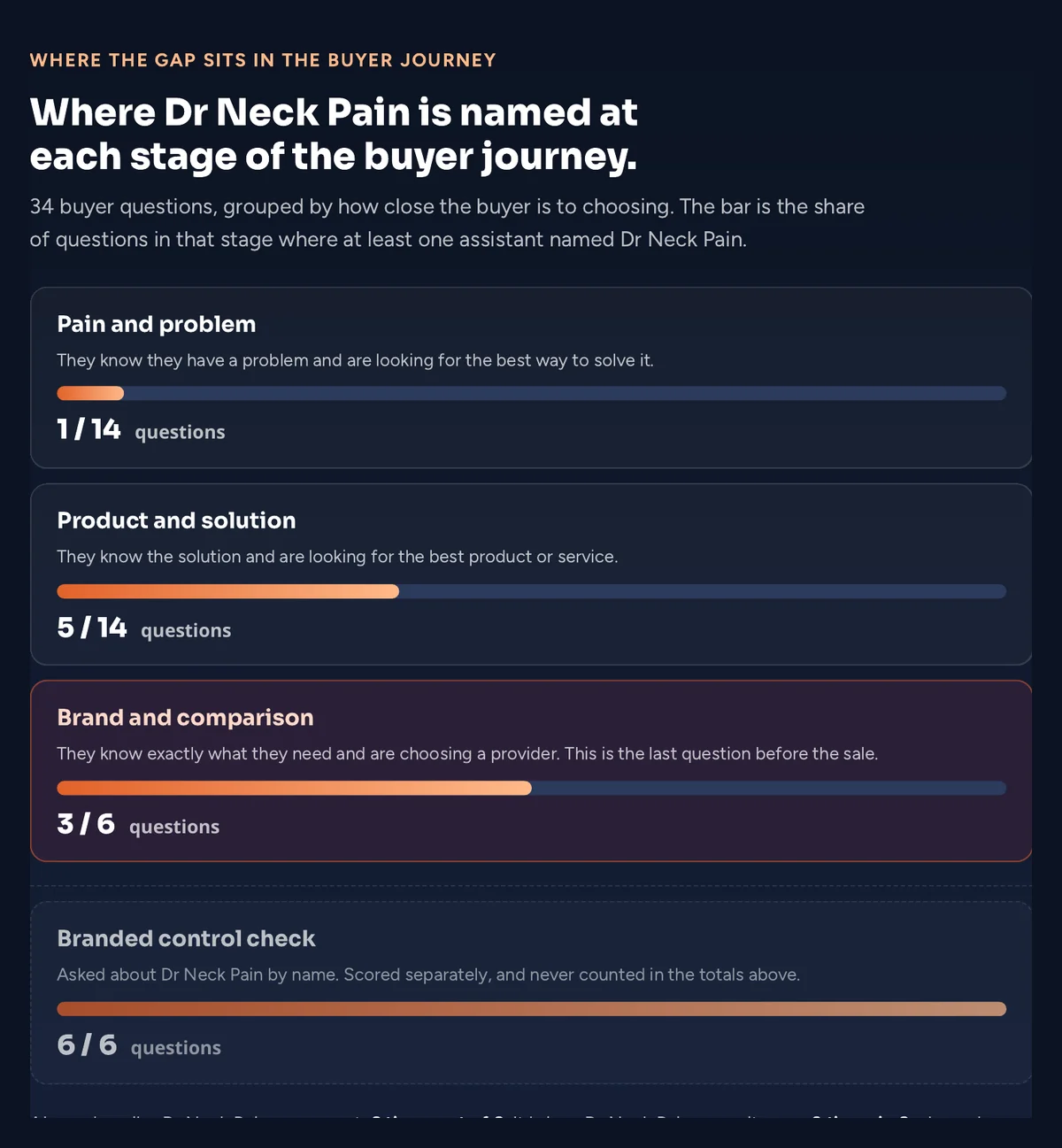
Grouping the questions by stage is what makes the result useful. When patients described their pain, the clinic above was named in 1 of 14 questions. When they were choosing a provider, 3 of 6. The early questions are where people decide what kind of help they need, so that is where a shortlist forms without you.
You can do this by hand in an afternoon. Or we run it for you in our free AI visibility audit, which asks around 40 questions on all five assistants. We explained what that report shows, page by page, in what an AI visibility audit actually looks like.
2. See who gets named instead, and why
Don’t stop at “we weren’t there”. Write down every name the AI gives instead, and read what it says about them. That list is your real competition in AI answers, and it is often not who you think.
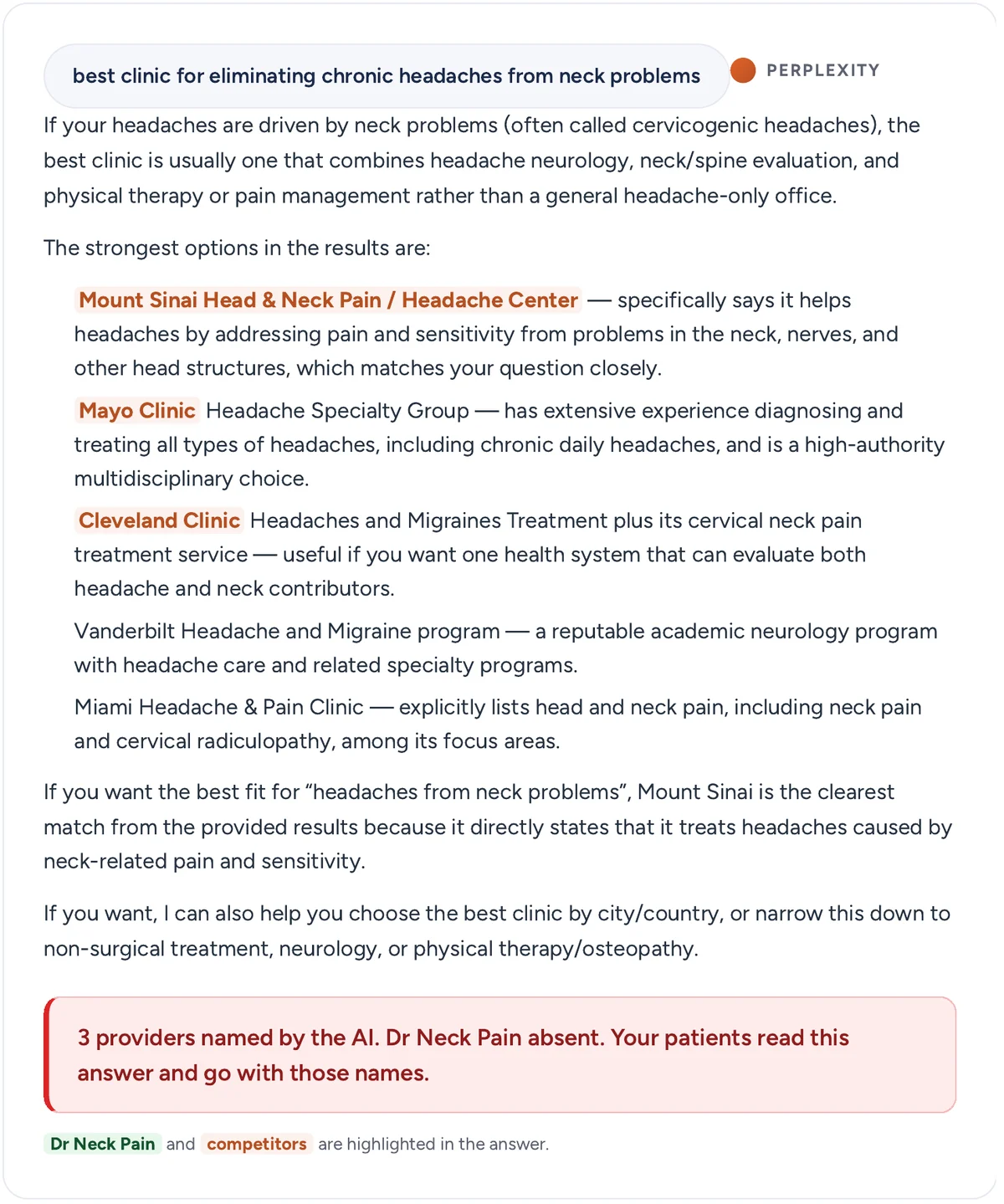
For a clinic in Bugis, the names that came up most often were Cleveland Clinic and Mayo Clinic. That is common in Singapore: when the local web is quiet on a topic, the AI fills the gap with whoever the global web talks about most. The reason a competitor gets named is usually written right there in the answer. “Known for”, “specialises in”, “reviewed as”. Those words came from somewhere, which is the next check. If it's a direct competitor who keeps getting named, we covered why ChatGPT recommends the business down the road instead of you.
3. Open the sources the AI used
Most AI answers show where they got their information: a list of links, a small icon next to a sentence, a “sources” button. Open them. Note what kind of site each one is: a news article, a “best of” list, a YouTube video, a forum thread, a directory, a competitor’s own page.
Pew Research Centre looked at Google’s AI summaries and found that 88% cited three or more sources. The three most-cited sites were Wikipedia, YouTube and Reddit. None of those is your website. The question isn’t only whether you rank. It’s whether you are in the handful of places the AI reads before it answers.
What to write down
For each question you lost: which sources were quoted, and whether your business appears in any of them. That list is your to-do list for check 4.
4. Check where you are talked about outside your own website
This is the biggest lever on the list, and the one most checklists put last. Search your business name and your main service together, and look at what comes up that you don’t own.
- Other people’s “best of” listsAre you in the local roundups for your category? If there are ten lists and you are in none, that alone explains a lot.
- News and articlesHas anyone written about your business, quoted you, or published your view on your topic?
- Video and audioIs your name said in any YouTube video, podcast or interview? In the Ahrefs study, YouTube mentions had the strongest link to being named by AI of anything they measured.
- Forums and communitiesReddit, local Facebook groups, HardwareZone threads. Is anyone recommending you where people ask for advice?
- Directories and profilesThe listings that matter in your industry, with the same name, address and phone as your website.
If most of those come back empty, the fix is not a better homepage. It is being published, steadily, in the places the AI already reads. That is exactly what MultiCasting, our publishing service, does: it turns one topic into articles, videos, podcasts, and news pieces, published across hundreds of sites every month. We covered the step-by-step side in how to get your business mentioned in ChatGPT.
5. Answer every question at every stage, on your own site
Your own website matters, just not in the way the technical lists suggest. Page count doesn't move the answer. What matters is whether your site has the best answer to the exact question a customer is asking. And customers ask very different questions depending on where they are.
- Something's wrongThey describe the problem in their own words. “Why does my neck hurt every evening after work?”
- What is it?They try to name it and understand the cause. “Can a stiff neck cause dizziness?”
- What are my options?They compare approaches. “Physio or chiropractor for neck pain?”
- Who should I pick?They look for providers, areas and prices. “Neck pain clinic near Bugis.”
- Is this one right for me?They check the business itself: what happens on the first visit, what it costs, whether it's legit.
Most business websites only answer the last two. The first three are where people decide what kind of help they need, and where the AI forms its shortlist. If the best answer to “can a stiff neck cause dizziness?” is on your site, you're in the conversation before anyone searches for a clinic.
What “the best answer” looks like
- It answers in the first linesThe direct answer first, then the detail. The AI quotes the part that answers.
- It's specificSingapore prices, places, timings and situations, not general advice anyone could write.
- It comes from real experienceWhat you see in your work every week, which nobody else can copy.
- It covers what they'd otherwise phone to askHow long it takes, what happens, what it roughly costs, when you're not the right choice.
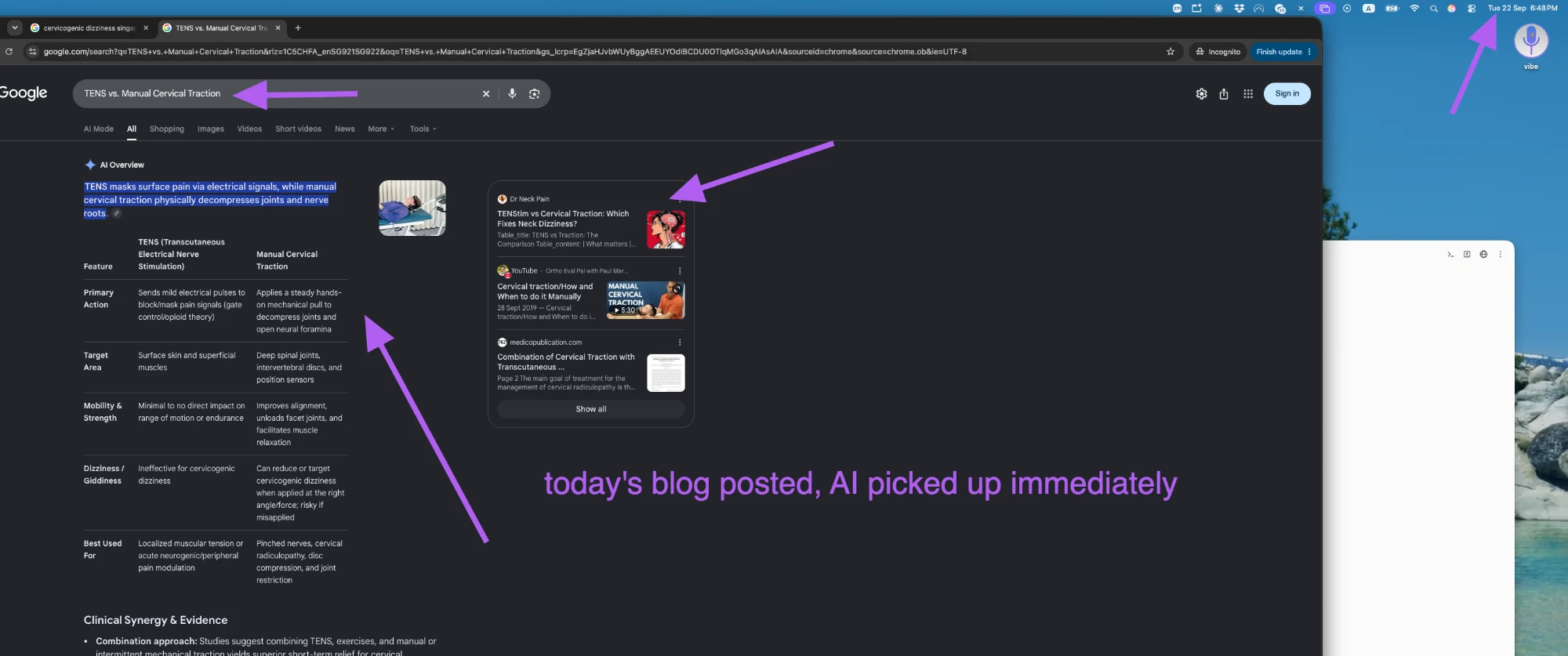
That page answered one narrow question, a comparison of two treatments, directly and in plain words. About two hours after it went live, Google’s AI was quoting it. Narrow questions like that move first. Broad, competitive ones take longer and require steady work. We looked at which kinds of pages get quoted most in the content ChatGPT cites.
The check: take your list of questions from check 1, sort it into the five stages, and next to each question write the page on your site that answers it. Where there's a blank, that's a page to write. Where the answer is thin or generic, that's a page to rewrite. Where two pages answer the same question, merge them. Clinics: keep these guides educational and factual, which is also what the MOH rules ask for.
6. Put your proof in public, within the rules for your industry
AI answers lean on facts they can repeat: what you do, for whom, where, since when, at what price range, with what results. If those facts exist only in your head or in your sales calls, the AI can’t use them. Publish the ones you’re allowed to.
For most businesses, that means real numbers, examples of work, clear prices or price ranges, and who is behind the business. Clinics have tighter limits.
If you run a clinic
Licensed medical, dental and aesthetic clinics in Singapore follow MOH’s advertising rules: no patient testimonials, no before-and-after photos, no words like “best”, no comparisons with other providers. Physio, chiropractic and TCM practices also can’t advertise a skill for treating a specific ailment to attract patients. Your proof is factual: services, qualifications, how you work, where you are. Check your own case against MOH’s guidance before publishing.
7. Check your Google profile and reviews
When the AI names you, most people look you up next. Your Google Business Profile is usually the page they land on, and for local questions, Google’s AI reads it too.
- Same details everywhereName, address, phone and website identical on your profile, your website and your directory listings.
- The right categories and servicesListed the way customers describe them, not only the way your industry does.
- Recent reviews that say somethingA steady flow, with detail about what you did. A last review from eight months ago loses the comparison.
To see how you look next to your nearest rivals, run the free competitor matchup. If the map is your gap, that’s what Ranked., our Google Maps service, fixes. Not sure whether you're missing from Google or just sitting low? Run the one-minute test for invisible versus ranking low.
8. Test what happens when AI sends someone to you
No other checklist asks this, and it’s the most expensive gap on the list. Getting named is the start. The person then messages you, often in the evening, often on WhatsApp. If the reply comes the next morning, they’ve already booked whoever answered first.
The check: message your own business at 9pm on a weekday, on WhatsApp and through your website. Time the reply. Then do it on a Sunday.
If the answer is “tomorrow”, the 30-second revenue leak check puts a number on it. Booked. is how we close it: every enquiry answered within seconds and booked into your calendar, day or night. We looked at this gap, and the other leaks most AI tools leave open, in what AI agencies sell versus what a business actually needs.
How to repeat the checklist every month
AI answers move from week to week. One check tells you very little. The same questions, asked the same way every month, tell you what’s actually changing.
- Keep one question listAdd new questions when customers ask them, but never swap the old ones out, or you can’t compare.
- Same day, same wayLogged out, all five assistants, around the same date each month.
- Watch the narrow questions firstThey move first. The broad ones follow with steady work. Both are progress.
- Look at the sources, not just the namesBeing quoted as a source usually comes before being named as a recommendation.
How we know
We run this on ourselves too. Our site has schema, added automatically by our SEO plugin. On 24 September 2026, we asked Google what Get Brand Exposure is. Its AI answered the general phrase “brand exposure” and never mentioned our business.
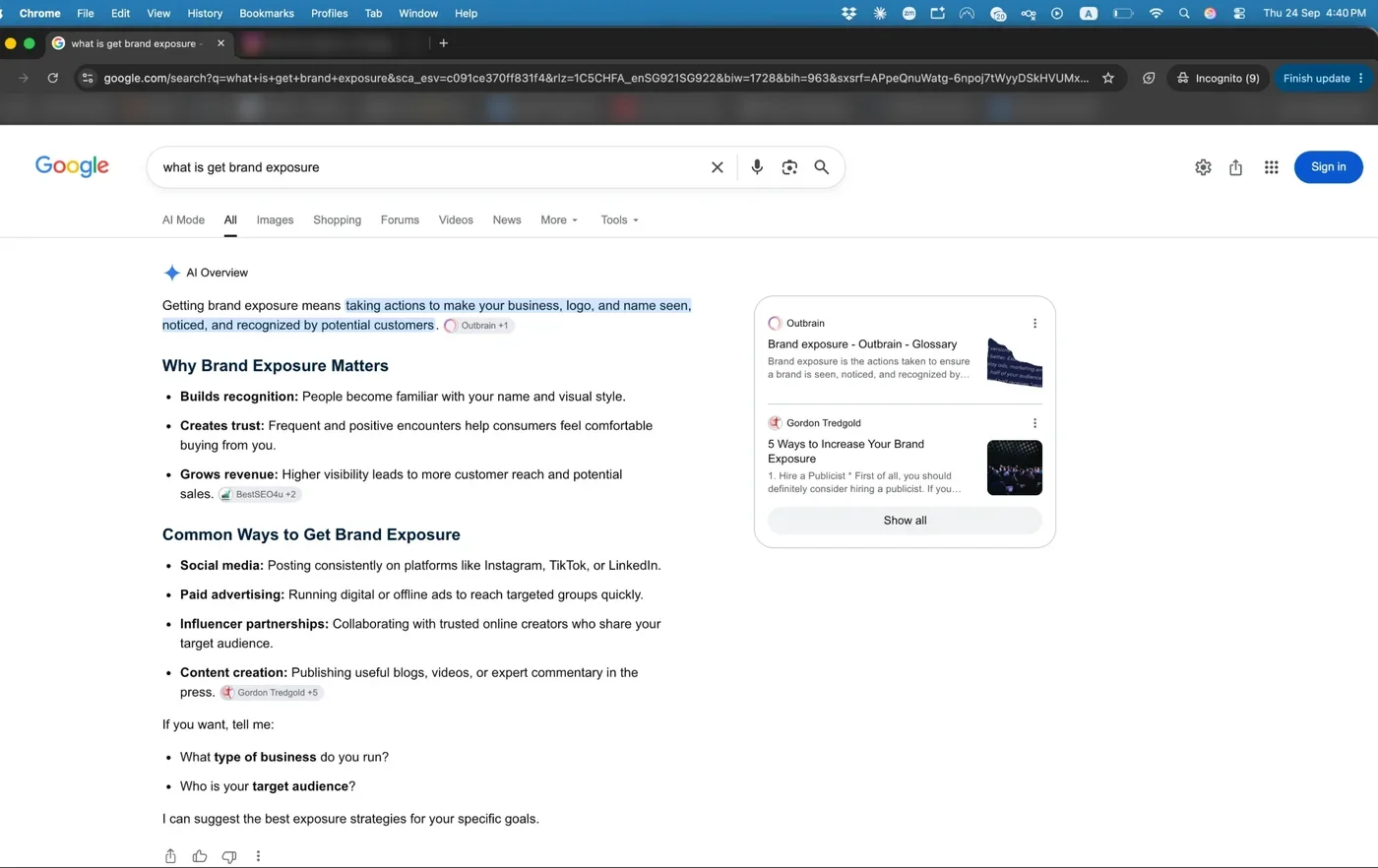
Google, Singapore, private window, 24 September 2026, 4:40pm. Our own starting point.
We opened our offer to the public this month. A new name doesn’t appear in AI answers within a fortnight, and we tell clients the same. So we’re running this checklist on ourselves in the open, month by month. The clinic in this post is where that method has already shown what it can do.
Tick your own AI search visibility checklist
Go through the eight checks for your business. Tick what’s already true. Anything left unticked has a free check or a next step beside it.
Your checklist
Not yet? Get the free AI visibility audit and we’ll run them for you.
The audit lists every name, question by question.
Open the sources on three answers you lost. It takes ten minutes.
Not yet? That’s the gap MultiCasting closes.
Sort your questions into the five stages and find the blanks. Which pages get quoted most.
Start with the three facts customers ask about most.
Run the free competitor matchup.
Not yet? Run the 30-second revenue leak check.
Questions owners ask
What should an AI search visibility checklist include?
The answers first, the code last. Ask the questions your buyers ask on all five AI assistants, see who gets named and why, open the sources the AI used, check where you’re talked about outside your site, and make sure each question has a clear page. Then check your Google profile and how fast you reply. The technical part is a short sanity check, not the main event.
Do I need schema markup or llms.txt to show up in AI answers?
They’re a small lever, not the gate. Structured data helps a machine read a page it has already found. It doesn’t make the AI recommend you, and it’s common: the Web Almanac found it on 41% of pages in 2024. For a small business, this ten-minute check covers the technical side. Where you’re talked about matters far more.
How many questions should I test?
Twenty or more, across the whole buying journey. Three “best [service] in Singapore” questions only test the last step. Include the problem in the customer’s own words, the options they compare, and the moment they choose.
How often should I run the checklist?
Monthly, with the same questions. AI answers change often, so one check tells you little. The same list every month shows what’s really moving.
How long before AI starts naming my business?
Narrow questions can move fast; broad ones take steady work. Google’s AI quoted a single comparison page about two hours after it went live. Being named for “best [service] in Singapore” takes much longer, because you’re competing with everyone the web already talks about.
Can I do this myself or do I need an agency?
You can do checks 1 to 3 and 7 to 8 yourself in an afternoon. Check 4, getting talked about in many places every month, is the part most businesses need help with, because it’s steady publishing work. Our free AI visibility audit does checks 1 to 3 for you. If you're comparing agencies, see what AI search agencies in Singapore actually deliver and how to judge a visibility agency before you sign.
Start with the check that matters most.
We ask the questions your customers ask, on five AI assistants, and show you who gets named instead of you. Free, done by hand.
Get My Free AI Visibility Audit ↗References
- Ahrefs. Top Brand Visibility Factors in ChatGPT, AI Mode, and AI Overviews (75,000 brands studied). YouTube mentions correlation about 0.737; branded web mentions 0.66 to 0.71; number of site pages about 0.194. Read 25 September 2026. ahrefs.com
- HTTP Archive. Web Almanac 2024, Structured Data chapter. JSON-LD found on 41% of pages in 2024, up from 34% in 2022. almanac.httparchive.org
- WordPress.org plugin directory, active installations as listed on 25 September 2026: Yoast SEO 10+ million, Rank Math SEO 4+ million, All in One SEO 2+ million. wordpress.org
- Webflow Help Center. Add schema markup in Webflow to improve SEO and AEO (“generate contextually relevant markup for your page with a single click”). help.webflow.com
- Wix Help Center. Add Structured Data Markup to Your Site's Pages (preset markup on pages such as Wix Stores product pages). support.wix.com
- Pew Research Center. Google users are less likely to click on links when an AI summary appears in the results, 22 July 2025. 900 US adults, March 2025 browsing data. 88% of AI summaries cited three or more sources; Wikipedia, YouTube and Reddit most cited. pewresearch.org
- Get Brand Exposure. AI visibility audit for a Singapore chiropractic clinic, 8 September 2026 (34 questions, five assistants). Google captures of 22 and 24 September 2026, private window. Search Console, Generative AI features report, fortnights 19 August to 1 September and 2 to 15 September 2026.
- Ministry of Health, Singapore. Healthcare Services (Advertisement) Regulations 2021 and Healthcare Services Act s 31A guidance.
AI answers change often, and results for one business don’t predict results for another. Nothing here is legal advice; clinics should check their own advertising against MOH’s guidance.