You ask ChatGPT for a clinic like yours in your area, and it names a competitor. Not because they are better. Because the AI decided they were the safer recommendation, and here is exactly how it makes that choice.
Written for owners of clinics, salons, studios and local shops in Singapore. Not for SEO agencies.
Key takeaways
- ChatGPT does not rank pages. It picks names. You can sit third on Google and still be missing from the answer entirely.
- It decides from two things: what it already learned about you from the open web, and what it looks up live when someone asks.
- Being written about elsewhere beats anything on your own site. In independent analyses, roughly four in ten of its picks trace back to third-party “best of” lists.
- There is no ChatGPT business profile to fill in. You earn the mention. You cannot register for it.
- You can see what it says about you in two minutes, and the test at the end shows you how.
Why your competitor gets picked and you don’t
Here is the part that catches people out. You can rank third on Google for your service, have a tidy website, and still be completely absent when someone asks ChatGPT the same question. The two systems are not playing the same game.
Google ranks pages, so it hands back a list and lets the person choose. ChatGPT does something different. It reads the web, forms a view of who the trusted names are, and then says two or three of them out loud. So the goal is no longer to rank on a page. Instead, it is to be one of the names the answer includes.
You are no longer trying to rank. You are trying to be included in the answer.
Everything below follows from that. Old habits like keyword density and backlink counts were built for ranking a page. They do very little to get your name into a spoken recommendation.
Search gives a list. AI gives a recommendation.
For years, search worked like a directory. You typed a question, you got ten blue links, and you did the choosing. Today, when someone asks an assistant or types a full question into search, they often get one clear answer instead of a page to sort through. The system picks the winners for them.
Think of walking into a restaurant and asking the waiter what is good. A good waiter does not read you the whole menu. He names one dish, with confidence. AI answers work the same way, and your job is to be the dish the waiter names without hesitating.
The name doesn’t matter
Some people call this GEO, or AI search optimisation, or a dozen other acronyms. Ignore all of it. The plain version is the only version that matters: be the business the AI names when a customer asks.
How ChatGPT actually decides
Two systems sit behind every recommendation. Once you see both, the whole thing stops feeling like a black box.
What it already learned about you
Most of ChatGPT’s knowledge is baked in from everything it read across the open web before you ever asked. It is looking for a clear pattern: does this business get mentioned, again and again, in the same breath as its category and its place? If “acne scar treatment in Tampines” and your clinic’s name appear together across many trusted sources, the model builds a strong link between the two. If they never appear together anywhere but your own site, that link is weak, and a weak link rarely gets spoken aloud.
What it looks up live
For anything that needs to be current, ChatGPT also searches the web in the moment, then builds its answer from the pages it pulls back. Two things follow from that. First, it can only use your pages if it is allowed to read them, so a site that blocks its crawler is invisible to this step. Second, it leans on pages that are clear and easy to quote, and on sources it already trusts, rather than on clever marketing copy. So the live step rewards the same thing the learned step does: a clear, consistent, well-covered presence across the web.
Named in many trusted places, described the same way, kept current. That is what both halves reward.
You do not have to hack an algorithm. You have to be genuinely, visibly present in the places the AI reads, so it has something confident to say about you.
Why “best of” lists beat your own blog
This is the part most owners get wrong. They pour effort into their own website and wonder why the AI ignores it. The reason is simple: what you say about yourself counts for very little. What others say about you counts for almost everything.
In independent analyses of ChatGPT’s recommendations, a large share, around four in ten, trace back to third-party “best of” lists, roundups and expert guides. Reviews carry heavy weight too. So does being listed in the directories and community sites the model already trusts. In short, the AI is checking whether the wider internet agrees you are good, not whether your homepage claims it.
Old SEO thinking
- Rank my own pages higher
- More keywords, more backlinks
- Publish on my own blog
- Win the click
AI recommendation thinking
- Get named on other people’s sites
- Be described the same way everywhere
- Earn reviews and list mentions
- Win the recommendation
Singapore, specifically
Singaporeans cross-check before they buy. They read Reddit, HardwareZone, curated lists like The Smart Local and Honeycombers, and Google reviews before deciding. When an AI answers a Singapore question, it leans on those same local hubs. So being present and well-reviewed there is not vanity. It is the raw material the AI uses to recommend you.
The same business, judged by two different sets of rules.
| What it weighs | Google ranking | ChatGPT recommendation |
|---|---|---|
| Your own website | Central | Minor |
| Mentions on other sites | Helps | Decisive |
| “Best of” lists and roundups | Minor | Around 4 in 10 picks |
| Reviews | A factor | Heavy weight |
| Clear, quotable pages | Helps ranking | Needed to be quoted |
| Keyword density | Fading | Close to useless |
How to get your business recommended by ChatGPT
You cannot log in and fix this. There is no ChatGPT business profile, no form, no directory you register with. You earn the mention the slow, real way, and it comes down to three moves.
Get written about in the right places
The single biggest lever is being covered on sites that are not your own: articles, guides, reviews, roundups and local lists, all describing what you do in the same clear way. One clinic mentioned across twenty trusted sources beats one mentioned only on its own homepage, every time. This is why broadcasting one clear message everywhere, month after month, does the work your own blog never can.
Make your pages easy to quote
When the AI does read your site, help it lift the answer cleanly. Use plain, question-shaped headings a customer would actually ask. Put a short, direct answer, a sentence or two, right underneath each one. And keep the machinery like schema in the background where your web person can add it, because it helps the AI understand what you do without changing a word the reader sees.
Show real proof
AI answers reward businesses that look genuinely credible, and skip faceless service pages. So name the practitioner, with real credentials. Show outcomes and case studies. Publish what you actually know, not marketing fluff. For a Singapore clinic this doubles as protection: keep it educational and factual, in line with the medical advertising rules, and you build trust with the AI and stay on the right side of MOH and the advertising standards at the same time.
Which approach actually gets you named?
There are a few ways to get covered across the web, and they are not equal. Here is how they compare on the things that decide whether AI ever names you.
| Approach | Who does the work | How long it lasts | Does AI pick it up? |
|---|---|---|---|
| Do it yourself: guest posts and outreach | You, every month | Only while you keep it up | Slowly, if you stay consistent |
| Mass-produced AI content on your own site | A tool | Spikes, then filtered as spam | Briefly, then dropped |
| Traditional SEO or “AI SEO” agency | Them, on technical fixes | Sets the floor only | Rarely changes who is named |
| Done-for-you multi-format publishing | We do | Compounds month after month | Yes, named across trusted sources |
The short answer
The most reliable way to be named by AI is the one that earns the most trusted coverage for the least of your time: one topic, turned into many formats, published across hundreds of sites the assistants already read, and kept current. Done by hand it is a team’s job. Done for you, it is what Get Brand Exposure does.
Doing all this by hand, every month, is a team’s worth of work.
Turning one topic into articles, video, audio and social, then placing it across hundreds of trusted sites and keeping it current, is why most owners read a post like this, nod, and never do it. It is also exactly the work we take off your plate, so your name starts showing up in the answers without you becoming a full-time publisher.
Want to see who ChatGPT names instead of you, and why? The free audit runs your real customer questions across ChatGPT, Gemini and Perplexity, shows you the gap, and the plan to close it.
Get My Free Audit ↗Test it on your own business
Do not take anyone’s word for this, including mine. Four steps, and you can do the first today.
- Ask the question your customer asksOpen ChatGPT, Gemini and Google. Ask for a business like yours in your area, in plain words. Write down who gets named.
- See what it leaned onWhere it shows sources, note them. Lists, directories, review sites, news. Those are the places doing the recommending, not your website.
- Check whether you’re even in the runningAre you mentioned on any of those sources? Can the AI reach your site at all? If you appear nowhere off your own domain, that is your answer.
- Ask again in 30 daysAs new pages about you appear across the web, the answer shifts. Compare, then repeat. This is a rhythm, not a one-off.
2-minute self-check
Is AI recommending someone else?
Tick any that sound like you. A result appears as soon as one is true.
Your result will show here.
Early signs
You are not invisible yet, but the gap is opening. Run the free audit and see exactly where you stand.
AI is sending customers elsewhere
Three of four. Competitors are being named in your place, and the audit shows you who and why.
AI doesn’t know you exist
All four. This is fixable, but not by waiting. Start with the free audit, so we both know where you stand today.
By the numbers
Where AI recommendations actually come from
- Lists winIndependent analyses put roughly four in ten of ChatGPT’s brand picks down to “best of” lists, expert guides and roundups, not brand-owned pages.
- The audienceUse of AI for local recommendations jumped from 6% to 45% of consumers in a single year (BrightLocal, Local Consumer Review Survey 2026).
- No shortcutThere is no directory to join and no profile to claim. OpenAI’s own guidance is that it owes nothing to any site; it reads you, weighs you and includes you on merit.
- Reviews still countThird-party reviews carry heavy weight in what the AI is willing to recommend, in Singapore especially, where buyers cross-check everything.
Read together, these say one thing. You earn the recommendation out in the open, across other people’s sites. You do not build it inside your own.
How we know
On 17 September 2026 we searched “the best neck pain specialist” in a private window in Singapore. Doctors, surgeons and hospitals own that search. Yet Google’s AI Overview listed Dr Neck Pain, a chiropractic clinic we work with, second in its options, above a medical pain clinic and a private hospital group.
The clinic did not outspend anyone. Instead, it got published, in many places, on one clear message. That is the same mechanism this whole post describes, and it is why the method holds across Google’s AI and ChatGPT alike.
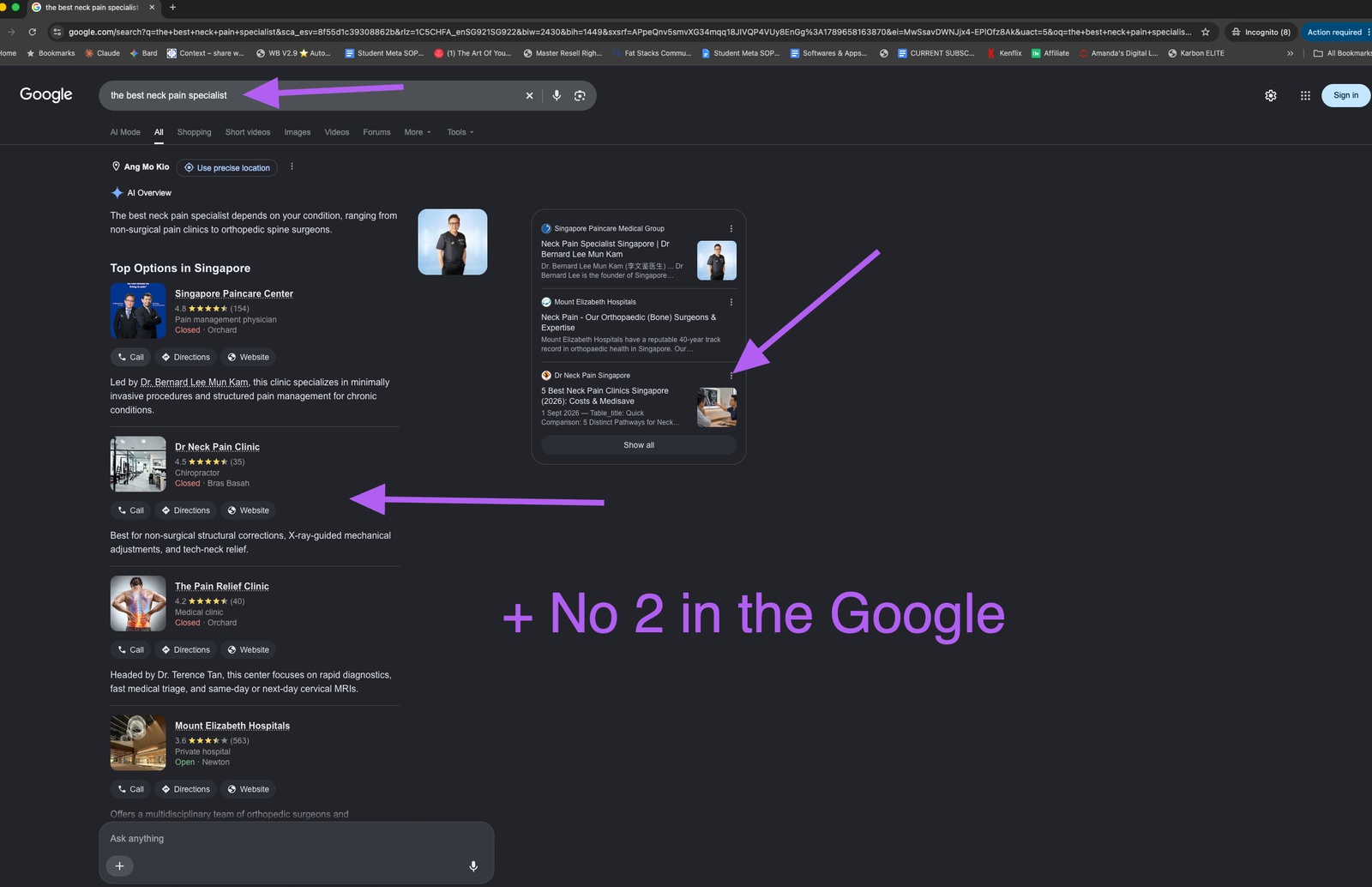
Google search, Singapore, private window, 17 September 2026. The clinic appears in the AI answer and among the cited sources.
Questions owners ask
Do I need to register my business with ChatGPT?
No, because there is nothing to register with. There is no ChatGPT business profile or directory. It reads the open web and licensed sources, then decides. You get recommended by being present and well-regarded out there, not by filling in a form.
Does my Google Business Profile help me in ChatGPT?
Indirectly. ChatGPT does not plug into Google Business Profile. But a complete, consistent profile keeps your name, details and reviews aligned across the web, and that consistency is exactly what helps the AI trust who you are. So keep it tidy. Just don’t expect it to be the whole answer.
Isn’t this just SEO with a new name?
No. The goal is different. SEO tries to rank your page so someone clicks it. This tries to get your name into an answer the person never clicks past. The work overlaps a little, but keyword tricks that move rankings do almost nothing for recommendations.
Doing it right
ChatGPT mentions us, but describes us wrong. Can that be fixed?
Yes, over time. It describes you from what the web says. When the accurate, current version of your story appears in more places than the old or wrong one, the description catches up. It is the same publishing work as earning the mention.
Do I need schema and technical work first?
It’s a small lever, not the main one. Clean, readable pages and a bit of schema help the AI understand you, and they are quick to add. But for a local business the big lever is being written about elsewhere, not a file on your own site.
I run a medical clinic in Singapore. Is this safe under the advertising rules?
Yes, when it’s done as education. What earns AI trust and what stays compliant are the same thing here: factual, useful content about what a treatment is and who it suits, with no “best clinic” claims and no patient result stories. You approve every topic, and your own compliance check always has the last word.
Be the name the AI gives.
The free audit shows who ChatGPT, Gemini and Perplexity recommend for your service today, and what it takes to change the answer.
Get My Free Audit ↗Read next
References
Primary sources, from OpenAI and Google directly:
- OpenAI. How ChatGPT search works, and how sites become eligible (OAI-SearchBot, query rewriting). OpenAI Help Center. help.openai.com
- OpenAI. Shopping with ChatGPT Search (results selected independently, not ads; structured data and editorial sources). OpenAI Help Center. help.openai.com
- OpenAI. Introducing Shopping Research in ChatGPT. OpenAI. openai.com
- Google. AI features and your website. Google Search Central. developers.google.com
Independent background:
- The Conversation. AI Overviews have transformed Google search: how they work. Academic authors, RMIT University and Queensland University of Technology, June 2025. theconversation.com
Statistics cited above (named in the text, listed here for transparency):
- BrightLocal, Local Consumer Review Survey 2026, on consumer use of AI for local recommendations.
- Independent analyses of ChatGPT brand recommendations, on the share tracing to third-party lists and roundups.
Results vary by market and business. AI engines change how they source and rank without notice; the method is to be genuinely present across the web and keep publishing, not to chase one answer.